
Stormwater requirements that influence commercial site design
Commercial stormwater requirements shape site layout long before construction starts. The core issue is how runoff, erosion, sediment, pollutants, and long-term drainage responsibilities will be controlled without creating permit delays, maintenance burdens, or avoidable redesign.
Stormwater planning snapshot
- Stormwater planning affects grading, entrances, utilities, paving, landscaping, phasing, and construction sequencing.
- In the United States, EPA rules generally require permit coverage for construction stormwater discharges from sites disturbing one acre or more, or smaller sites that are part of a larger common plan of development.
- A compliant plan is not just a drawing; it must match site conditions, contractor means and methods, inspection routines, and post-construction maintenance.
Start with the permit trigger, then test the site reality
The design team should confirm the governing stormwater authority before schematic site design becomes too fixed. Federal, state, county, municipal, watershed, and utility requirements may all influence a commercial site. EPA's overview of stormwater discharges from construction activities explains the federal construction stormwater permit trigger, but local rules can be more specific about detention, water quality volume, green infrastructure, redevelopment, and outfall protection.
On real projects, the trigger is only the first question. A site with steep slopes, clay soils, high groundwater, adjacent wetlands, contaminated fill, public sidewalks, or limited laydown space may need more careful controls than a larger but simpler parcel. Designers should also check whether the project changes impervious area, redirects flow, disturbs a floodplain, or connects into a constrained public storm system.
Design decisions that change stormwater performance
Stormwater is often treated as a civil engineering submittal, but design choices across the project influence runoff and maintenance. Roof area, downspout locations, loading docks, pedestrian plazas, parking grades, dumpster pads, fuel areas, landscape islands, and snow storage areas can all affect pollutant loads and drainage behavior.
| Design choice | Stormwater impact | Early coordination question |
|---|---|---|
| Building placement | Changes drainage paths and available detention space | Can runoff reach treatment areas without excessive piping? |
| Parking geometry | Drives impervious area and inlet locations | Can islands or edges support bioretention or pretreatment? |
| Construction entrance | Controls sediment tracking during work | Is there room for vehicle washdown and maintenance? |
| Utility corridors | Compete with basins, swales, and tree trenches | Are conflicts visible before final grading? |
| Roof drainage | Concentrates flow at leaders and scuppers | Are discharge points protected from erosion? |
A project that treats stormwater as a late detail often pays for it through regrading, utility relocation, lost parking spaces, or extra retaining walls. A project that addresses it early can use the same site features for drainage, landscape, circulation, and owner maintenance access.
Connect the SWPPP to actual construction sequencing
The Stormwater Pollution Prevention Plan, usually called a SWPPP, must reflect how the contractor will build the project. EPA provides Construction General Permit resources and SWPPP templates that can help teams understand the required categories of information, but the document still needs project-specific judgment.
A useful SWPPP connects erosion controls to construction phases. Clearing, mass grading, underground utilities, foundations, paving, landscaping, and final stabilization each create different risks. Controls that work during mass grading may not protect finished pavement from sediment during utility rework. A basin designed for permanent runoff control may not be ready to perform during early earthwork unless temporary measures are specified.
Protect receiving waters and neighboring property
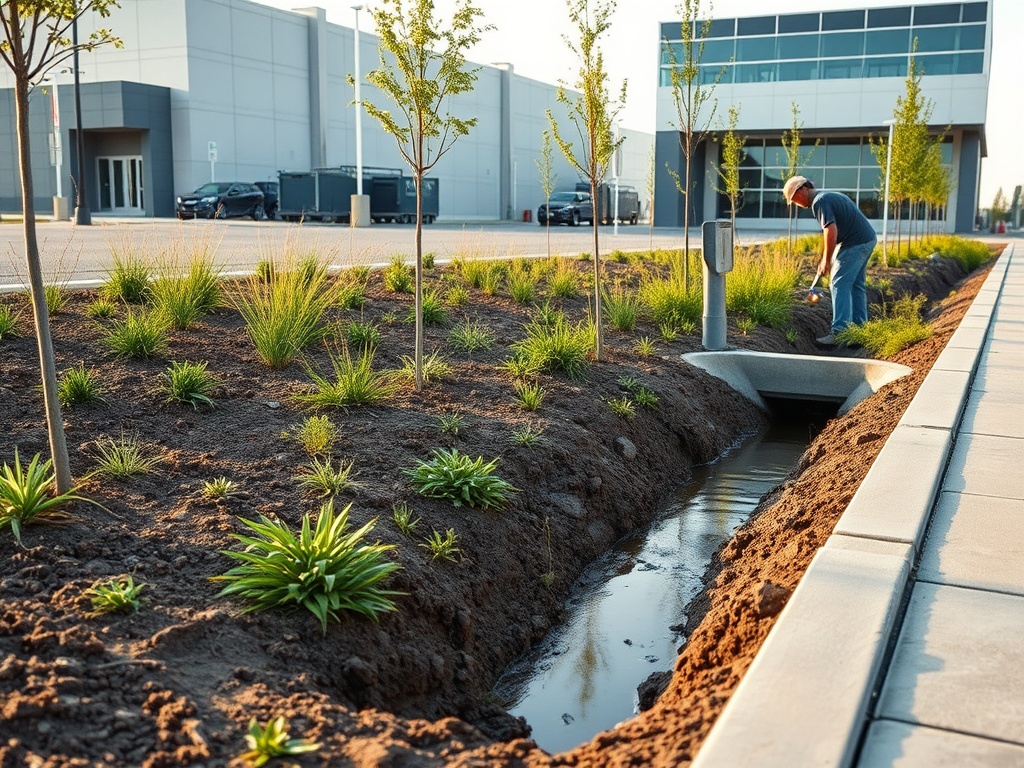
Stormwater compliance is partly about paperwork, but the field risk is physical. Sediment can leave the site through curb cuts, tire tracks, wind, failed silt fence, overloaded inlets, or concentrated flow. Concrete washout, fuels, paints, curing compounds, trash, and landscape chemicals can also become pollutants if they are not controlled.
The design should make good behavior practical. That may mean room for stabilized construction entrances, sediment traps, protected stockpile areas, washout zones, covered storage, inlet protection, and safe inspection access. Contractors should not be left to improvise controls after every rain event.
Internal coordination matters here. If the owner is also planning future service work, the same disciplined approach used to build profitable service divisions can help assign responsibility for post-construction drainage inspections, cleaning, and repairs.
Watch the handoff from temporary to permanent controls
Many stormwater problems show up during the transition from construction controls to permanent systems. Temporary swales are removed before final stabilization. Inlets clog before turnover. Sediment accumulates in basins that are later expected to meet water quality performance. Landscape areas are installed but not maintained long enough to establish vegetation.
The handoff should identify who removes temporary controls, who cleans permanent systems, who verifies elevations, who receives maintenance manuals, and who owns recurring inspection duties. EPA's Construction General Permit frequent questions can help teams understand how compliance concepts apply, but the project contract should still define responsibilities clearly.
A closeout record for stormwater assets should include as-built drainage plans, basin details, inlet locations, inspection logs, cleanout records, plant establishment notes, and maintenance contacts. Without that record, facility teams may not know what they inherited until a flood complaint or enforcement issue appears.
Avoid common design and construction mistakes
One frequent mistake is underestimating off-site flow entering the property. Another is assuming that a flat site is simple; flat sites can be difficult because small grade errors affect drainage. Designers also run into trouble when stormwater facilities are squeezed into leftover spaces that are hard to access, unsafe to maintain, or visually unacceptable to the owner.
During construction, teams often fail when controls are not inspected after storms, when subcontractors remove protections for convenience, or when final stabilization is delayed. These are process failures, not only design failures. Clear responsibilities and field-level training are essential.
Projects that involve existing buildings should also coordinate stormwater with the difference between renovation, retrofit, and remodel. A tenant remodel may have little site impact, while a retrofit that changes drainage, equipment pads, or exterior access could trigger review.
Coordinate stormwater with facility operations
The design should also consider who will maintain stormwater assets after the contractor leaves. A basin that requires specialized mowing, a filter that no one can access safely, or an inlet that clogs behind parked cars can create recurring complaints. Facility teams should review access, inspection points, cleaning frequency, and documentation needs before approval. This is a general best practice, not a substitute for local permit conditions or engineering design.
Stormwater checklist before commercial site approval
Before approval, confirm the disturbed area calculation, receiving system, outfall locations, soil constraints, temporary controls, permanent treatment, inspection access, ownership of maintenance, and closeout documentation. The civil drawings, SWPPP, specifications, and construction schedule should tell the same story.
Stormwater requirements are not a generic compliance add-on. They influence site economics, constructability, environmental risk, and owner operations. The practical next step is to hold an early stormwater coordination review with the civil engineer, architect, contractor, owner, and facility representative before the site plan becomes difficult to change.